
7 Causes of Telecom Inventory Billing Gaps
Telecom inventory billing gaps occur when the services you’ve installed don’t match the services you’re billing for. The root cause of this is almost always disconnected systems: inventory lives in one system, operational data in another, sales in another, and billing in another. With nothing to reconcile the data into a source of truth, billing leakage is inevitable. But there’s more to it. Keep reading to learn about the seven common causes of billing gaps and what each one costs.
What Are Telecom Inventory Billing Gaps?
An inventory billing gap is any mismatch between what exists in the field (space, power, network) and what appears on customer invoices.
These gaps can be bi-directional: Services are delivered but not billed. Or services are cancelled and not disconnected in the field.
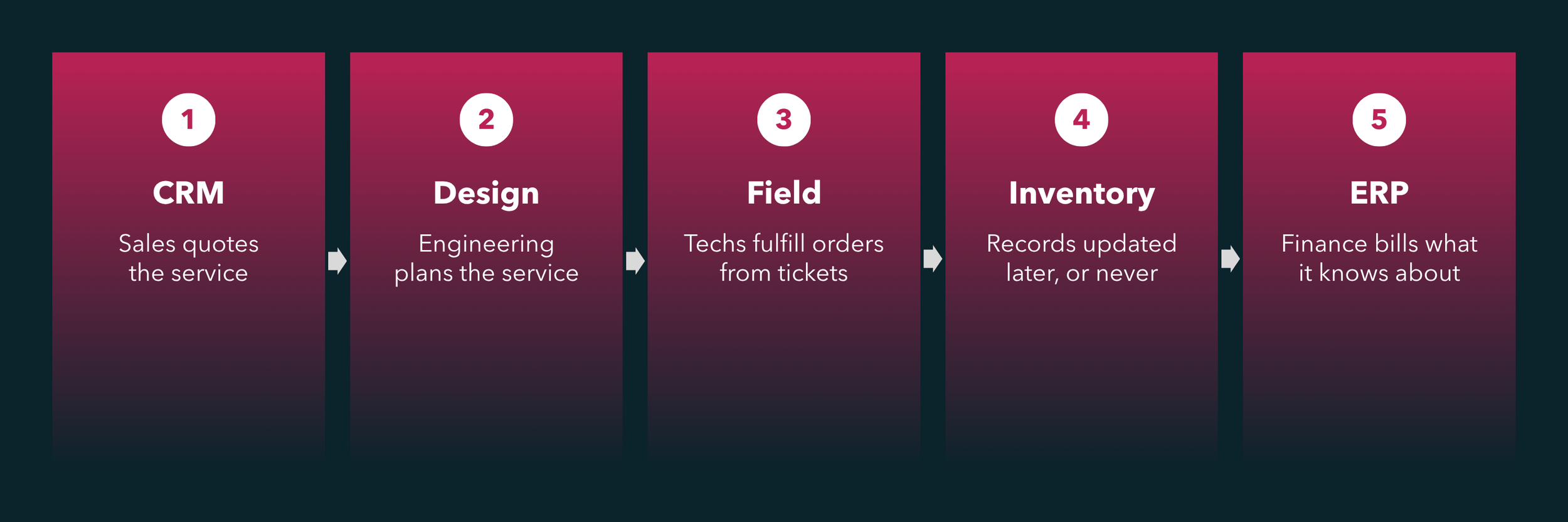
And there can be multiple sources of asset data inaccuracy. There are often several systems between your inventory management platform and your billing system. Each of these systems present an opportunity for inaccuracy.
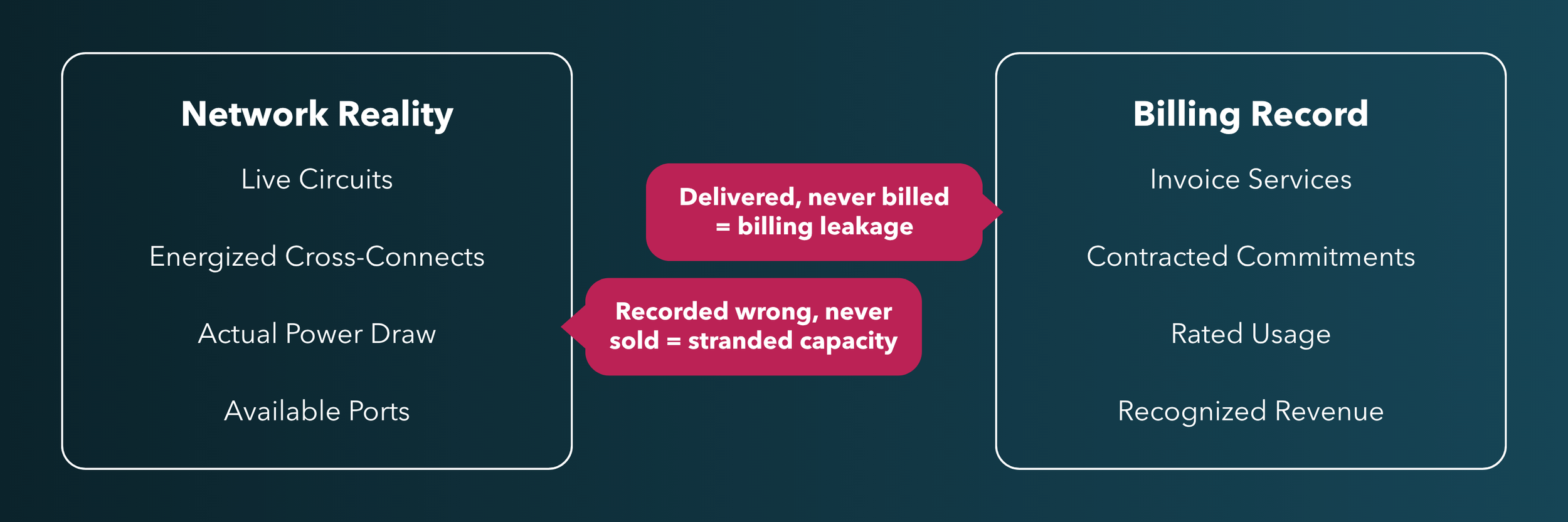
Each of these gaps can lead to billing leakage or stranded capacity. Given the seriousness of these issues, this problem has been an object of focus in the industry. And while TM Forum reports show that revenue leakage is down to 0.52% (compared to 1.22% in 2021), the problem persists.
Data inaccuracy is causing greater challenges across your business that might not factor into your billing leakage number:
AI can’t be trained on inaccurate data. This means that your internal AI use cases (to streamline processes, save time, and make more intelligent business decisions) are likely to be ineffective.
Slow or manual processes limit earning potential. Examples:
Needing to take extra time to validate capacity data to get a quote out. This gives your competition time to quote faster and win the deal.
Selling a certain design based on bad data, so it requires rework when the field team goes to install. This can lead to missing your customer requested date and forfeiting revenue.
Swivel chairs between systems, and general tech stack bloat, make employee onboarding more challenging. And, in some cases, creates bottlenecks and dependencies on the few individuals who understand how everything connects and works together.
Why Do Telecom Operators Struggle to Keep Network Asset Inventory Consistent?
Most operators struggle to reconcile gaps between their inventory and billing system because no single platform captures every order and change from end to end. And each handoff between a system (or a spreadsheet) is a chance for the record to diverge from reality.
That challenge is a big reason that Carma exists: to replace numerous point systems with enough industry specificity to unify your data across your tech stack.
The seven causes below touch on specific failure points within typical telecom tech stacks.
Cause 1: Siloed Systems That Never Reconcile
Disconnected systems are the most common cause of inventory billing gaps.
When quoting, network inventory, provisioning, and billing run on separate platforms with no shared data model, reconciling inventory and billing becomes a periodic, manual project.
A circuit that your customer disconnects could remain live for months before anyone compares the network record to the invoice.
Cause 2: Untracked MACDs That Create Zombie Services
When moves, adds, changes, and disconnects (MACDs) are executed in the field but never get updated in your inventory system, you end up with “zombie” services. These are circuits that were disconnected but still bill or upgrades that were delivered but still bill at the old rate.
Every untracked MACD costs you revenue:
Disconnect-side “zombies” eventually surface as customer disputes and credits.
Adds and changes create even worse revenue leaks because nobody complains about a service they aren’t being charged for, so they go on far longer without being discovered.
Cause 3: Delayed Installs Turn Bookings Into Forfeited Revenue
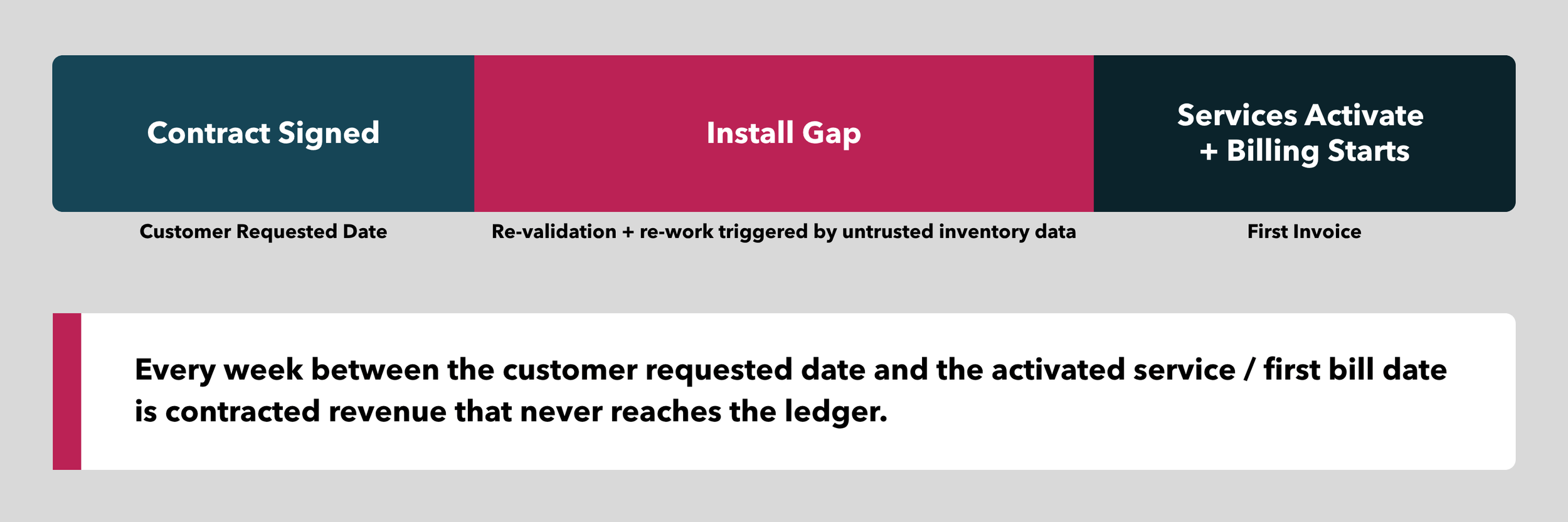
The install gap is the time between a customer’s contracted delivery date and the date service activates and starts billing.
Revenue lost in that window is forfeited: money the customer agreed to pay that the operator can never recover.
Inaccurate inventory data drives that gap. When teams can’t trust their network asset inventory data, they re-survey, re-validate, and re-design before every install.
Cause 4: Stranded Capacity That Sales Can’t See
Stranded capacity is infrastructure that has been built and paid for but can’t be sold because inventory records don’t show as available, such as:
Ports flagged as reserved for projects that ended years ago
Power provisioned for equipment that was decommissioned
Data centers can lose 10% or more of their UPS capacity to stranded power. That’s infrastructure built but not actually used by IT equipment.
Cause 5: Unbilled and Underbilled Power
Unbilled power is electricity a data center delivers to customers but never invoices, usually because power draw grows after install while the billing record stays frozen at the contracted commitment.
This tends to follow the same pattern: installed on a ticket, energized, and never added to the invoice. These are pure margin losses.
The service costs real money to deliver every month, and colocation operators rarely audit power billing against actual draw unless a customer forces the question.
Metered usage that never flows into a rating process is the single most direct form of billing leakage in colocation. If you want to learn about how our power agreement functionality can stop the leak, get in touch.
Cause 6: No Single Owner for Asset Data
Inventory billing gaps persist when network operations, finance, and IT each own a piece of the asset record and nobody owns the whole picture. Network operations optimizes the network, finance watches the invoice, IT owns the system, but not the data, and so on.
Without a clear owner responsible for data accuracy, it’s challenging to prioritize the major change management required to fix disconnected systems and processes.
Cause 7: Data Decay That Blocks Automation and AI
Asset data decays every day that it’s not maintained. This is a trickle down effect, impacting or blocking downstream initiatives that depend on good data, such as AI.
57% of data leaders cite data reliability as a key barrier to moving AI projects from pilot to production.
For operators, that means automated reconciliation, churn prediction, and capacity forecasting all stall on the same foundation problem.
How Do You Close Telecom Inventory Billing Gaps?
Closing inventory billing gaps requires one data model that connects quoting, network inventory, provisioning, and billing, so every asset change flows to the invoice automatically.
Platforms built for the full lead-to-cash workflow, like Carma, treat the asset record and the billing record as one record, which removes the reconciliation step entirely.
Want to size the problem first? Start with our Unbilled Power Calculator and find out how much revenue you’re losing to power leakage.
Frequently Asked Questions
-
Description Industry-wide leakage averaged 0.52% of total revenue in TM Forum's latest Business Assurance Survey, down from 1.22% in 2021. Individual operators vary widely, and inventory-driven losses like stranded capacity and forfeited revenue don't appear in leakage statistics at all, so the true cost of inventory gaps is larger than leakage figures suggest.
-
Physical inventory is tangible assets: racks, cables, ports, patch panels, and power infrastructure.
Logical inventory is the services configured on top of them: circuits, VLANs, wavelengths, and IP assignments.
Billing gaps often start where the two meet, when a logical service changes without a matching physical record update, or the reverse.
-
One accountable owner should hold the complete asset record, with network operations, finance, and IT working from the same system rather than reconciling separate copies. Which function owns it matters less than the singularity of the record. Most persistent billing gaps survive because three teams each trust their own version.
-
Continuously, if systems allow it. Where reconciliation is still often a manual project, quarterly is a practical minimum for revenue-bearing assets like circuits, cross-connects, and metered power.
-
AI can accelerate detection, but only on top of reliable data. Most AI adopters cite data quality as their top deployment challenge. Fixing the underlying asset data consistency comes first. AI applied to a broken inventory automates the errors.