
Forfeited Revenue: The Hidden Cost of Late Service Installs for CSPs and Data Centers
By Frank McDermott, CEO & Co-Founder
Your customers sign contracts, telling you exactly when they’ll start paying. And if your team can’t hit that date, that revenue is gone. Not delayed. Not deferred. Gone.
The Metric Your Finance Team is Missing
Every carrier and data center operator (wholesale, enterprise, SMB) leaves revenue on the table when services install after the Customer Requested Date (CRD).
The CRD is contractually binding: it’s the date the customer will start paying for service if the provider can deliver it. Yet most operators track performance against the Firm Order Commit (FOC) date instead—a promised install date derived based on internal processes, inventory, and cycle times.
Although some companies measure the days from the CRD to install and others track the percentage of installs completed on time, neither metric captures what delays actually cost you.
There’s a better metric that translates every late install into a dollar amount management can act on: Forfeited revenue. This is the total dollar value of services a customer has agreed to pay for that is permanently lost when services are not delivered according to customer expectations (the CRD).
Forfeited revenue measures how effectively you’re converting signed orders into collected revenue and is a powerful customer experience signal since every dollar of forfeited revenue represents an unmet commitment.
Calculating Forfeited Revenue
Calculating forfeited revenue is easy with your existing install reports. You simply multiply the number of days late you were on your install and your daily recurring revenue.
This tells you how much revenue your customer was committed to paying, that you didn’t collect.

Here’s an example of this in action: A few years ago, we calculated the total forfeited revenue for every order installed by a large North American carrier (roughly $1B in annual revenue).
This carrier averaged a staggering $563k every week, totaling $29.85M for the year.
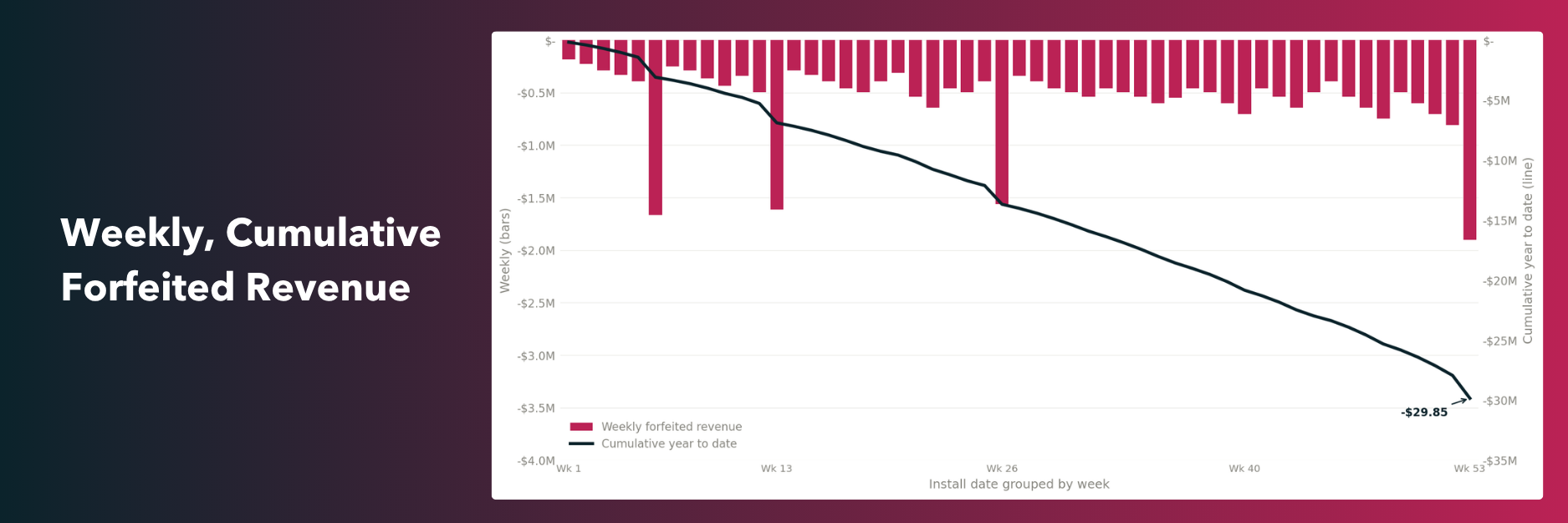
Looking at their data, there were key spikes in forfeited revenue tying directly to end-of-month install pushes where teams rushed to hit monthly revenue targets, with a year-end peak of $1.83M in a single week.
Had this carrier captured the 3% of revenue their customers had already committed to paying, they would have increased EBITDA nearly 10%.
Root Cause of Forfeited Revenue
Reducing forfeited revenue requires reducing install time—specifically, the gap between when work could be done and when it actually gets done.
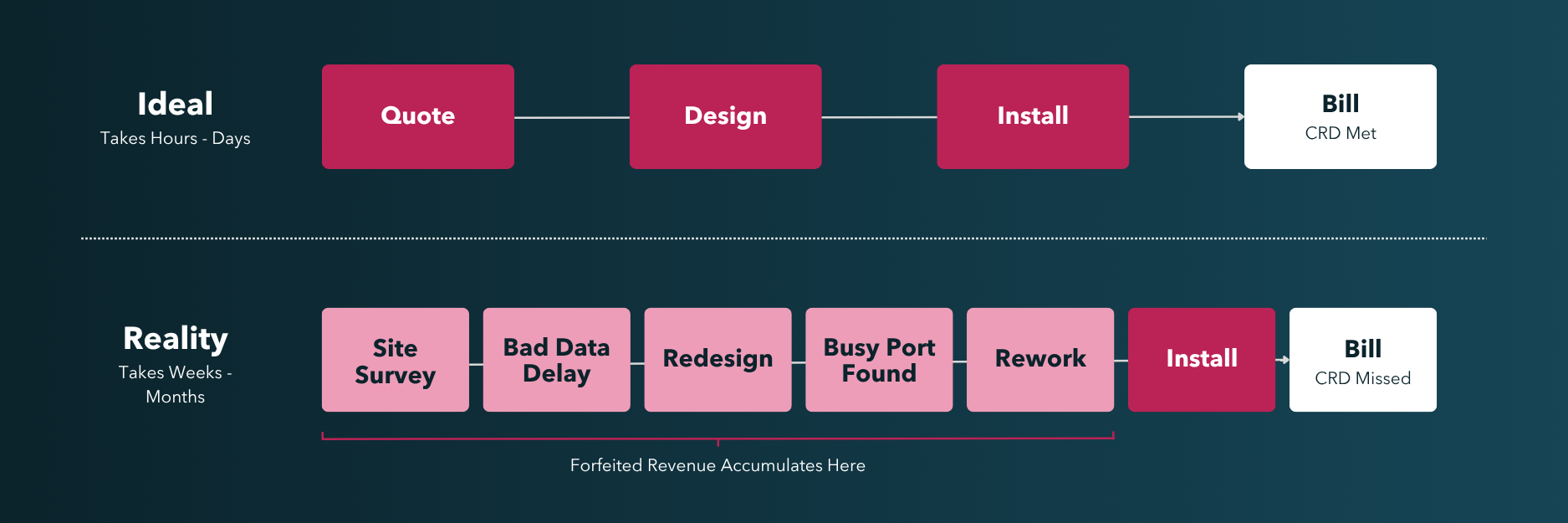
Sounds simple, right? Well, here’s what most teams miss: the actual hands-on work for a new install is measured in hours. The weeks (or months) surrounding the install are almost entirely caused by rework and waiting. And the cause of rework and waiting to confirm capacity is inaccurate inventory data.
Why Data Integrity Matters
When your data foundation is strong—if every network element, fiber span, channel, jumper, and port is accurately captured—every install should be quick, easy, and accurate on the first try. No rework. No need to wait.
And you’d get true automation in design, provisioning, and installation.
But the reality for most companies is very different. Every install is a battle from the start, sometimes before the sales team has even quoted the order.
Weeks of delay are common when:
Buildings can’t be confirmed as on-net, off-net, or near-net
Fiber and equipment availability requires a site survey because no one trusts the inventory system (or spreadsheet)
This leads your sales team to force deals through the system with downstream effects:
Engineers design circuits on bad data
Field techs regularly encounter busy ports
Every misstep costs you. Every time you rework an install, it pushes delivery further off track.
The Cause of Inventory Data Inaccuracy
Our research shows that 21% of structured wiring physical inventory data is inaccurate. And defect rates of consumable inventory can reach 68% across a single data center.
At that defect rate, a single fiber cross-connect completes successfully on the first attempt just 62% of the time. Scale that to a service requiring five cross-connects, ten connections (both ends), and first-pass yield drops to 9.5%.
The causes of these discrepancies are well understood. In our experience, the biggest contributors are:
Physical changes, like new installs, “next available” allocations, disconnects, and backlog, that never make it back into the system of record
No remote monitoring capability for passive fiber panels, making it impossible to verify task completion without a site visit
M&A activity with incomplete integrations and data fallout from inventory migrations
Spreadsheet audits that never sync back to the system of record
Outdated LOA/CFA transmission processes
Inventory systems siloed between organizations, with no shared visibility
The result of these data issues is that daily transactions for new installs consume all available time. The rework tasks pile up, meaning an end-of-month scramble to catch up is inevitable.
And because your teams are stuck in reaction-mode, the data stays bad, and forfeited revenue grows at an accelerating rate.
How to Start Reducing Forfeited Revenue
From individual order interventions to multi-year system investments, forfeited revenue is a baseline measure to prioritize and execute improvement programs.
The best way to eliminate delays is to improve network inventory data, but doing that isn’t always straightforward.
To start, carriers and data center leaders must prioritize improvement projects based on the forfeited revenue they’re most likely to recover, relative to their cost.
Busy Customer Facility Assignment (CFA) is a good example. When a CFA is occupied, but the inventory didn’t reflect that, it triggers a circuit redesign and revised Letter of Authorization (LOA). Each busy CFA instance, typically:
Occurs 1 – 2 days before the CRD
Causes a 2 – 4 week delay
Creates a direct, traceable link between a single inventory error and measurable forfeited revenue
Generates escalation situations that show up in CSAT scores
Where Carma Fits
Programs that produce real, lasting improvements to your system of record—not spreadsheet audits that don’t sync back—consistently deliver the highest returns to network operators. And because they improve existing operations, rather than replacing them, the implementation risk is low.
Every system—quoting, ordering, provisioning, workflow—performs better when the inventory feeding it is accurate. Rework drops. Install timelines compress. And forfeited revenue shrinks.
Carma was built on exactly this thesis: siloed, inaccurate inventory data is the root cause of operational dysfunction. A unified, connected data model is what enables everything to work.
From inventory management and circuit design to CPQ and order-to-cash, Carma connects the data that drives every install decision.
If you want to calculate your own forfeited revenue and understand where your gaps are, talk to our team.
Author Bio
Frank McDermott is the CEO and co-founder of Carma. He created Carma based on his first-hand experience in the industry—from the construction, operation, and management of fiber networks, data centers, and microwave & cellular networks, as well as consulting across the industry prior to founding Carma. Frank holds a Bachelor's from Georgetown, a Masters in Project Management from George Washington, and a Lean Six Sigma Black Belt from Villanova. Prior to entering the telecommunications industry, Frank served a distinguished career in the United States Air Force.