Why Data Center Inventory Data Becomes Inaccurate
In your data center, there are services running that aren't on an invoice. Power circuits consumed but not billed. Capacity shown as “available" that isn’t.
That gap doesn't happen all at once. It builds across system migrations, staff turnover, manual handoffs, and all the times someone forgot to update a record or update every disparate system.
Why Data Center Inventory Data Drifts Over Time
Data center environments are in constant motion. Installs, decommissions, customer upgrades, power reconfigurations—these changes happen daily across operations, sales, and finance. When each team logs changes in its own systems (or forgets to), the records diverge.
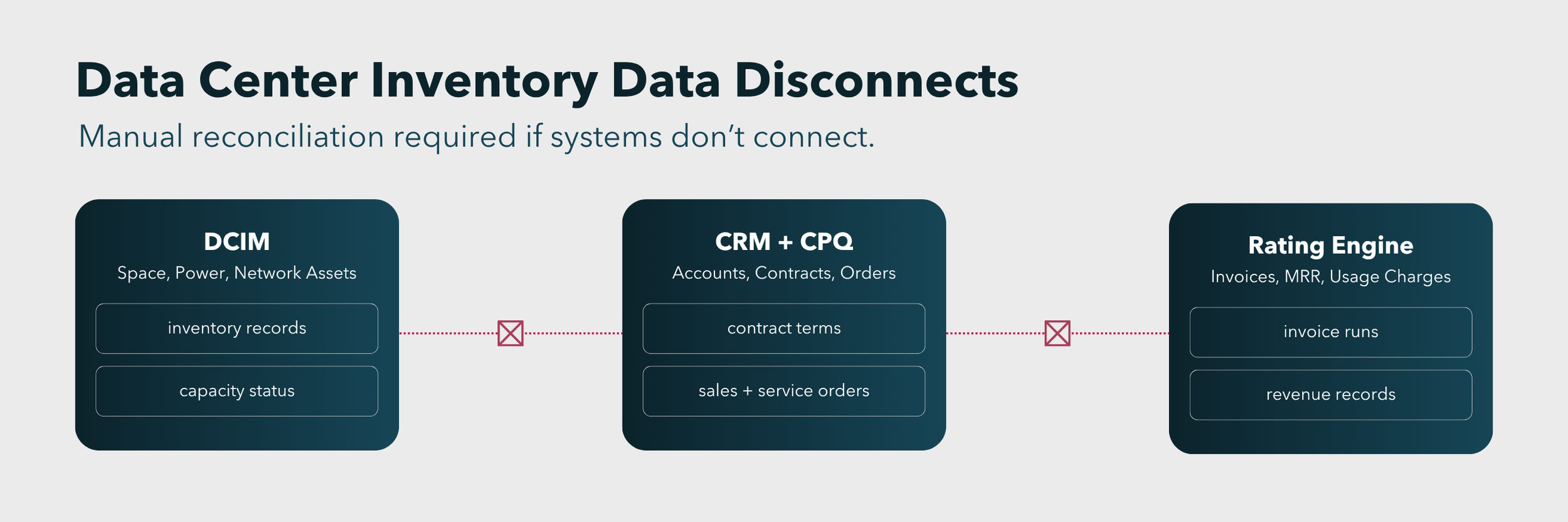
The problem compounds because most data center inventory management (DCIM) systems aren’t designed with a unified data model. The DCIM is often separate from the CRM, where customer contracts live, and your billing system.
When critical systems don't speak to each other, someone must manually reconcile them, which is time consuming and error prone.
Industry research finds that companies still using spreadsheets, with no standardized data management practices have inventory data accuracy below 70%.
Where Inaccuracy Enters the Business
Operations
Operations teams depend on inventory accuracy to do their jobs.
Capacity planning, installation scheduling, field audits, and maintenance routing all require a reliable picture of what's deployed, where, and at what status.
When that picture is stale, teams make decisions on bad data.
Sales commits to capacity that's already consumed
Engineers provision into space that doesn't exist as modeled
Audits reveal discrepancies that take days to reconcile
Manual spreadsheets, still common across the industry, compound the problem by introducing version control issues and data entry errors that compound over time.
The result is stranded capacity: installed resources that can't be used or sold because their status isn't accurately reflected in the system of record.
At scale, the costs add up. A 500-rack facility with just 5% stranded capacity can waste $200,000 to $375,000 annually in operating costs alone.
Sales and Quoting
Inaccurate inventory data directly impacts what you’re able to quote and sell.
Sales teams quoting from stale or disconnected inventory data either over-promise on availability or under-sell out of caution. Both outcomes cost revenue.
Quoting errors get worse when power, space, and connectivity aren't managed together.
A cage might show as available, while the associated power circuit is already at capacity
A port pair might be logged as available when the physical infrastructure shows otherwise
Without a live, connected view of all three, quotes become educated guesses and disputes follow. For high-velocity deal environments or hyperscale pre-leasing discussions, those guesses carry significant financial and reputational risk.
Finance and Billing
This is where inventory inaccuracy has its most direct revenue impact.
Billing accurately requires knowing exactly what each customer is consuming. When inventory records don't connect to billing systems, services get missed. Power gets undercharged. Billing items fall through the cracks between provisioning and invoicing.
The result is revenue leakage across the business: recurring charges that should appear on invoices but don't, often for extended periods before they're caught.
In the case of power, which fluctuates with usage and contract terms (PUE multipliers, IT utilization rates, power agreements), the complexity creates even more surface area for error.
Manual prior-period adjustments, credit-and-rebill cycles, and billing disputes are expensive to manage and damage customer trust. They're also largely preventable with the right data model in place.
Why the Systems-of-Record Problem is Getting Harder to Ignore
The infrastructure landscape is only getting more complex as AI workloads ramp up.
With increased costs, lease structures are also increasing in complexity, with usage-based billing, power agreements, and multi-currency contracts becoming standard.
How Carma Addresses the Root Cause
Carma's approach starts with the data model.
Every space, power, and network asset must be inventoried and connected to customer accounts, vendor expenses, and billing items from the start. And since Carma can connect all your data in one place, there’s no reconciliation layer between systems.
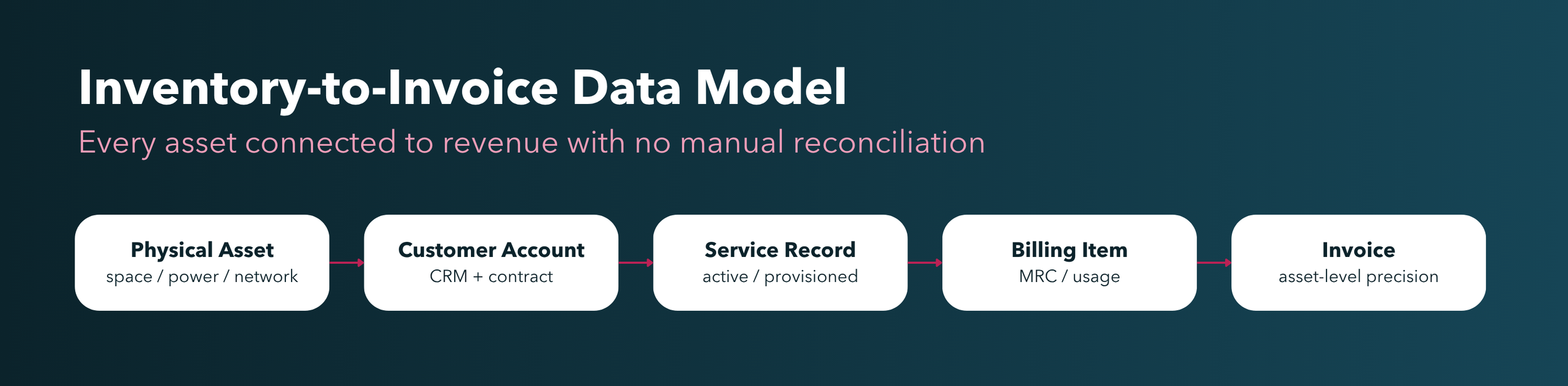
Inventory-to-invoice traceability. Carma connects physical inventory to revenue and expenses in a single data model. When a customer's deployment changes, the billing record reflects it. Underbilled services and missed billing items are surfaced automatically, not discovered in a dispute.
Industry-specific CPQ. Carma's configure-price-quote engine is built for digital infrastructure, meaning space, power, and connectivity are quoted together with real-time capacity visibility. Sales can commit accurately because they're quoting from live inventory, not a snapshot.
Revenue-grade power billing. Power is modeled as inventory down to the meter, with support for PUE calculations, power agreements, and kilowatt-level billing precision. This closes one of the largest sources of revenue leakage in colocation operations.
Field audit app. Carma's companion app allows field teams to complete audits faster and with greater accuracy, reducing the gap between what's installed and what's on record.
The goal is a single source of truth that operations, sales, and finance can trust simultaneously.
Understand the Revenue Gap Before It Grows
Inventory inaccuracy is a slow leak. It rarely shows up as a single catastrophic event. It compounds, quarter over quarter, until the gap between what you've deployed and what you're recovering is unmistakable.
Our Customer Revenue Gap Guide walks through how disconnected customer account data, inventory records, and billing systems create this gap — and what a connected data model looks like in practice.