
Carma vs. Point Systems for the Telecom Industry
Most communication service providers and data center operators don’t run their business on one system. With traditional systems, you end up stitching together numerous point systems. And there’s often gaps between each, not to mention tremendous customization needed to make those systems work for our industry.
The Point Systems Most Telecommunications Companies Use
The average telecom operator uses six to seven vendors to cover front-end, BSS, and OSS functionality. Though it’s not uncommon to see 20+ point systems overall.
And this comes at a great expense, so it’s no surprise that nearly all operators in McKinsey’s research said architecture simplification is critical to their future success.
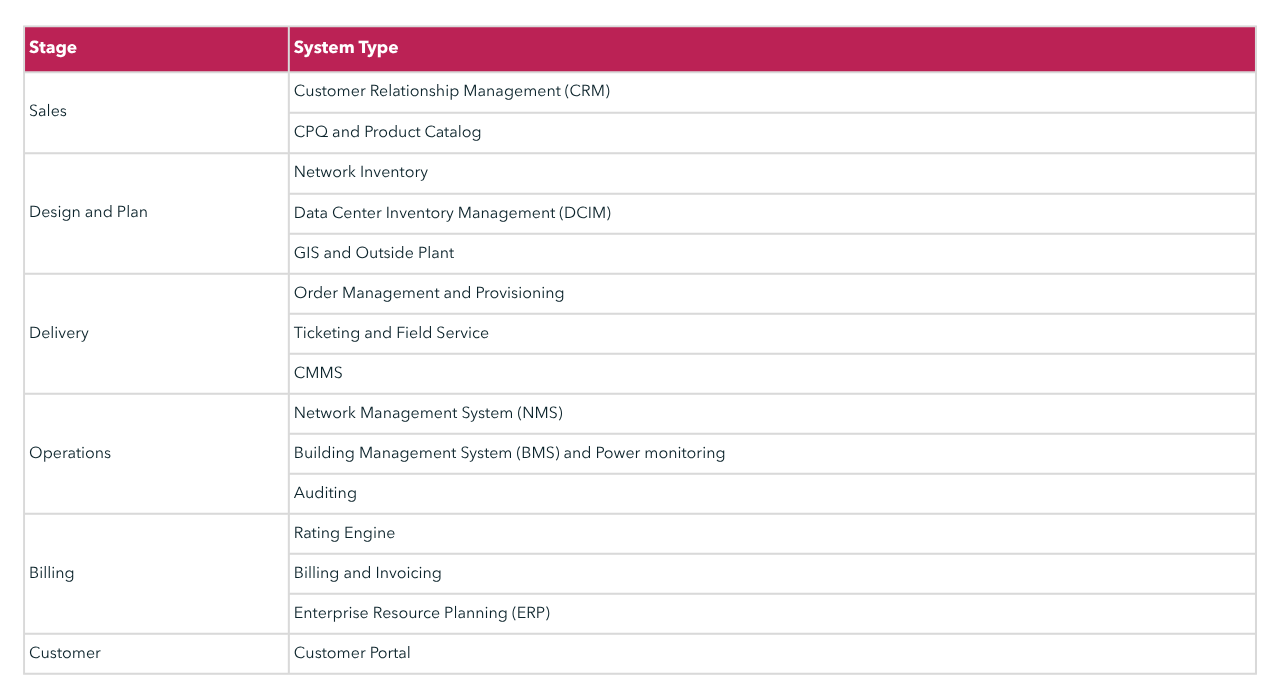
Why Operators End Up With a Stack of Point Systems
This architecture of point systems has a name: best-of-breed. On paper, each tool is the best at its job. So, each software decision seems reasonable. No tech leader is intentionally trying to build a fragmented tech stack.
But in practice, the seams between all these disparate systems are where revenue, time, and data quality erode. Between each system is an integration someone built that now has to be maintained.
And most of these “best-of-breed” systems aren’t industry specific. So, they often don’t work for the services you provide.
The point-system stack wins on license price and loses on almost everything downstream of it: cost, speed, data quality, and revenue captured.
Ultimately, this affects everything that matters to your bottom line. It impacts how fast you can launch a product, how clean your data is, and how much of your IT budget goes to just keeping the lights on.
The Cost of Point Systems for Telecom
IT Expenses
AI Roadblocks
Forfeited Revenue
Manual Labor Costs
Inaccurate Capacity
Point-System Architecture IT Expenses
The cost of a point-system architecture is more than the individual license costs; it’s the cost of connecting everything and maintaining those integrations. Every pair of systems that need to share data need an integration. Every integration requires maintenance. And every upgrade to one system risks breaking the link to another.
IT teams are spending 36 percent of their time designing, building, and testing new custom integrations between systems. Every system you add to the stack adds to that number.
The Strategic Downside of Fragmented Data
When your systems rely on integrations or manual updates, they are bound to disagree. In the telecom industry this challenge is rampant, with many teams relying on numerous point systems and spreadsheets to keep operations running.
For a network or data center operator, "data silos" shows up as a customer receiving a service that no system is billing for. As capacity marked available in one system and sold in another. As a dispute that takes three logins and a spreadsheet to resolve.
A unified platform like Carma doesn’t have this problem because it becomes your one source of truth. The order, the provisioned service, and the invoice all reference the same data.
And when you have a data foundation you trust, you unlock the ability to use your data for internal AI use cases.
AI and automation need clean, connected, real-time data. Fragmented systems cannot provide it. This is now the single most common reason AI initiatives fail:
63% of organizations either lack or are unsure if they have the data management practices needed for AI.
Through 2026, organizations will abandon 60 percent of AI projects that are not supported by AI-ready data.
You cannot run reliable automation, predictive provisioning, or an agentic workflow on data that lives in six systems that disagree with each other. A unified data model is the prerequisite for all of it.
Every Handoff Is Delay, and Delay Is Forfeited Revenue
Every day between a signed order and a live, billed service is forfeited revenue.
Point systems add delay at every handoff.
The quote moves to the order system.
The order moves to provisioning.
Provisioning then has to signal billing.
Each transfer is a queue, a batch job, or a person re-keying data.
A unified platform collapses those handoffs. The quote becomes the order becomes the provisioned service becomes the bill, on one data model, without a re-key or a batch job in between.
Manual Labor Costs
Typically, even with integrations, there is still manual work required to move data between point systems. These swivel chairs cost hours of work and introduce even costlier errors.
Analysis from the Uptime Institute has found that nearly 40% of organizations suffered a major outage caused by human error.
For a data center operator, every re-key is a chance to get it wrong, and the cost ranges from a billing dispute to downtime.
Where Carma Fits
Carma brings power inventory, CPQ, order-to-cash workflows, provisioning, and a billing and rating engine onto a single unified data model, purpose-built for colocation data center operators and telecom and carrier networks.
We strategically integrate with just a few types of system: BMS, NMS, and your ERP. The data from your BMS and NMS can flow into Carma, enabling clean workflows (like NaaS and precise billing) and then culminate in clean, asset-level invoices that you can send to your ERP. This limits the number of systems you need to integrate with, letting Carma be a source of truth connecting everything.
That means:
One record from quote to cash, so there is nothing to reconcile between order, provisioning, and billing.
Capacity that stays visible and sellable, because inventory and billing reference the same data.
A data foundation your automation and AI roadmap can actually run on.
Less IT budget spent maintaining integrations and more spent on what moves the business.
The point-system stack is not one decision you can reverse. It is a hundred small ones that hardened into an architecture. Replacing the spine is the decision that undoes the rest.
Request a demo to see what system fragmentation is costing you.