
The Install Gap: Where Data Center Revenue Quietly Disappears
By Matt Mescall, Space & Power Product Manager
Securing power is the number one challenge in the industry right now. Then you’ve overcome hurdles to sell power to customers...but not everyone is talking about the problems that occur between sale and install.
That period between ‘sold’ and ‘billing’ isn’t mapped well by most data center operators. This is the install gap and it’s where a surprising amount of revenue is lost.
What is the Install Gap?
The install gap is the time between selling power and billing for it. Which, in our industry, can be months.
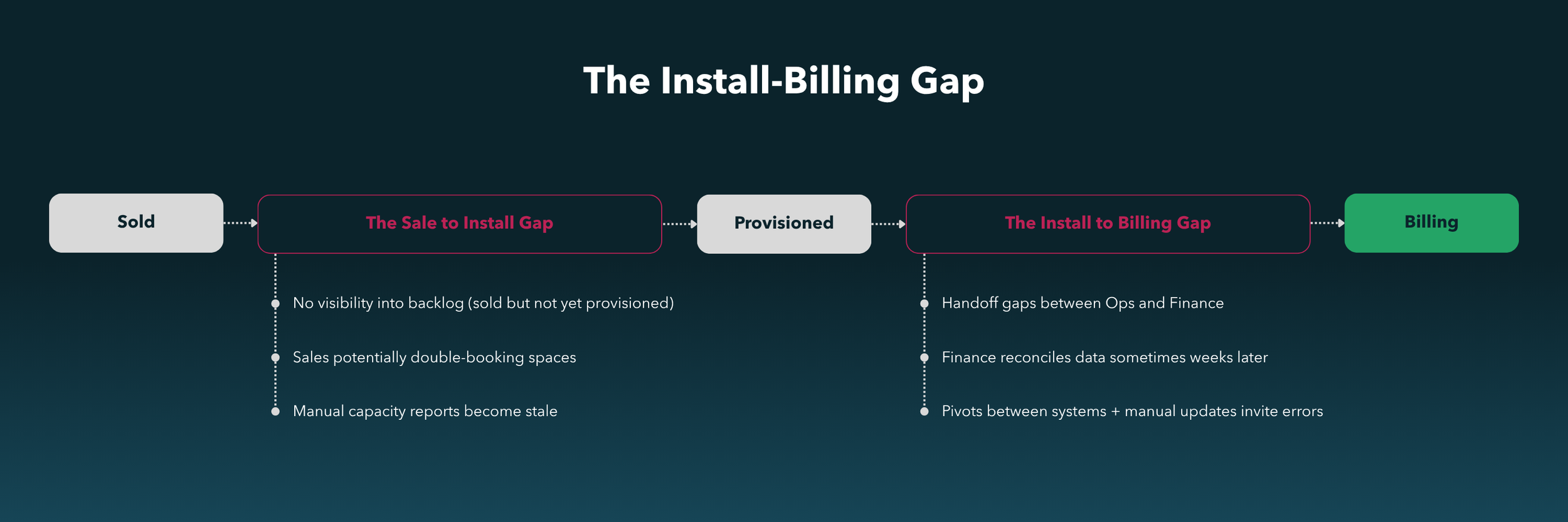
Without an end-to-end solution like Carma, most operators are relying on numerous point-systems and Excel to track power capacity and the state of their inventory. But that leads to a lot of small disconnects as power goes from ‘available’ to ‘in backlog’ to ‘provisioned’ to ‘actively billing.’
Each of those stages often lives in a different system. You sell through a CRM, contract in another, manage operations in a third, and bill through a fourth. When those systems don't talk to each other in real time, things get lost in translation.
A circuit gets energized, but someone forgets to update the billing system
A customer's power draw gets reassigned during a floor reorganization, but the paper trail doesn't follow
Two months later, someone in Finance notices the numbers don't reconcile, and now you're spending hours tracing a problem that should have never existed.
Operations are almost always the last to know. And by the time they find out, the gap has been compounding.
The Numbers Behind the Gap
Most of our customers estimate they have 15 to 20 percent leakage billing for power.
Some of that loss happens during this install gap from human error and gaps between systems. This leakage also comes from not having the right systems to embrace a Base + E billing model, which most customers are now requiring.
Here’s an example: A 10MW colocation facility that experiences 15% leakage leaves $1.65M on the table every year.
To put that in perspective, that’s like your billed power rate dropping from $0.09 / kWh to $0.0765 / kWh.
Said another way, that is like giving a 400 kW customer 3.8 months of free power.
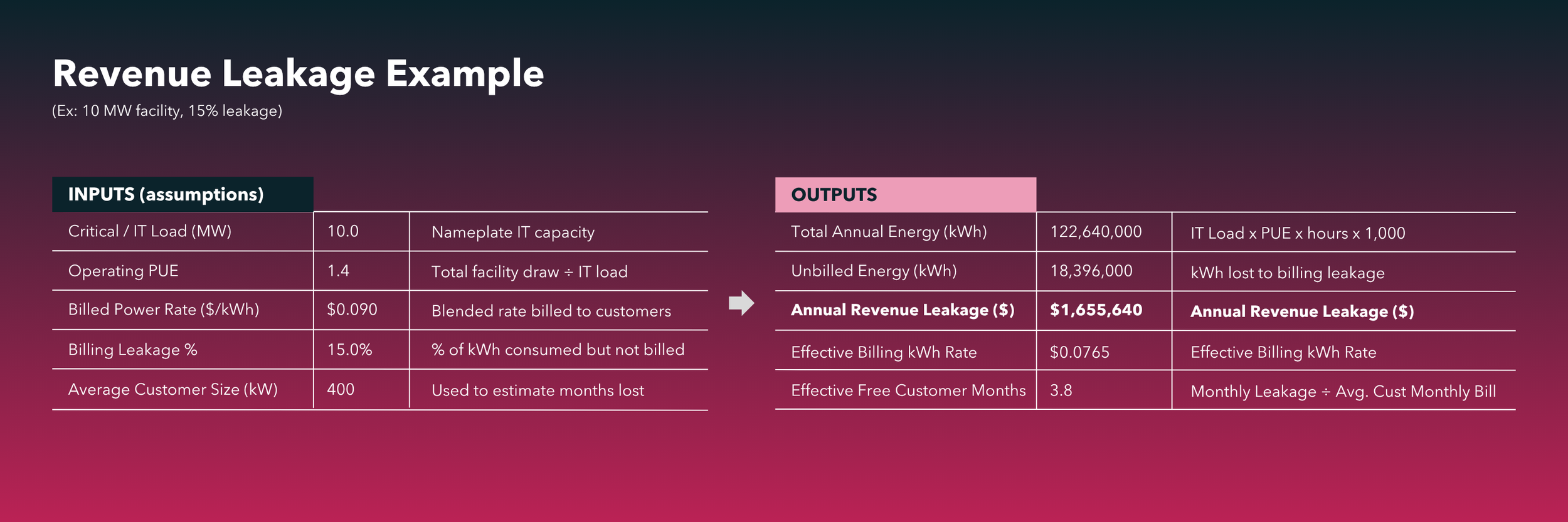
The root cause? Power that's been consumed but not accurately tracked, attributed, or billed.
Why Oversubscription Makes This Harder
The shift to Base + E billing models, where customers pay a committed base plus actual usage is the right move commercially. Customers, especially hyperscalers, expect it. It's become table stakes for competitive colos.
But metered billing only works if your usage data is accurate and your capacity tracking is real-time. If you're running a Base + E model on top of a patchwork of systems, you're likely to encounter more billing errors.
Under the old all-in breaker model, you billed for provisioned capacity regardless of usage. Sloppy tracking was expensive, but it wasn't as obviously broken. Under metered billing, every discrepancy between what was used and what was billed is a direct revenue hit.
What Good Looks Like
The fix here must be two-fold: software that can track power at every stage in the cycle and a different operating model. Here's what it looks like in practice:
Sales and operations work from the same inventory.
When a deal closes, Ops sees it immediately. Not at the end of the month when the spreadsheet gets updated. Not after a reconciliation meeting. The same day.
That eliminates the window where Sales is quoting off stale data and Ops is playing catch-up.
You have a clear picture of exactly where capacity is at every stage.
Available, sold, reserved, in backlog, provisioned, billing. Each of these stages should be visible to all teams in real-time
When capacity is tracked through every stage, the data gaps close and no sold capacity goes unbilled.
Bills are defensible down to the breaker.
When a customer disputes an invoice, you shouldn't need a remote hands ticket and three days to figure out if they're right. You should be able to point to the panel, the breaker, and the circuit, and show them exactly what was measured and when.
Oversubscription is a data-driven decision.
When you can see actual usage trends over time, oversubscription stops being a source of tension between Sales and Ops.
For instance, in colo environments, the average power draw is about 60%. If you can actually identify exact usage by customer and space, making decisions about oversubscription becomes much easier. And you’ll leave less revenue on the table.t to improve power management and billing?

The ROI of Getting This Right
The business case here isn't just about recovering lost revenue, though that's a significant part of it. It's also about what accurate data enables downstream.
Faster quoting. When the number is already there. In my experience, quoting power can take 30–60 days, sometimes longer. But when capacity is tracked in real-time, you're not waiting on an operations review to confirm availability.
Lower double-booking risk. A double-book damages the customer relationship and potentially your reputation in an industry where word travels fast. If two salespeople are looking at the same accurate inventory, the chance of promising the same capacity to two customers drops significantly.
Shorter sales cycles. Customers talk to multiple providers simultaneously. The operator who can answer a capacity question accurately and quickly is the one who builds relationships that lead to repeat business and referrals.
Better CapEx decisions. When you know what's actually being used and in pipeline, you can plan future capacity more precisely. That affects procurement timelines, utility negotiations, and build-out decisions.
Where to Start
If you're still managing any part of this on spreadsheets (or piecing together data from systems that weren't built to work together), an overnight overhaul isn't realistic.
I recommend starting with a pilot site.
Pick it based on where your pain is most acute. If it's billing accuracy, pick your most complex multi-tenant facility. If it's quoting speed, pick the site you're closest to capacity on. Run your proof of concept, learn from it, and roll it out from there.
The goal isn't to retire all your systems on day one. It's to establish a single source of truth for one site and see what changes.
In my experience, once operators see the gap close in one location, the case for the rest of the portfolio makes itself.
Author Bio
Matt Mescall is Carma’s product manager responsible for space and power functionality. With an engineering background and over 15 years of experience in data centers, Matt brings first-hand expertise to Carma’s product development.
Watch this on-demand webinar to get stated.