
The annual Pacific Telecommunications Council (PTC) conference is always a great indicator of where the industry is headed. In 2026, the focus was on power, AI, and transformation. From AI-driven demand to sustainability mandates amid increasing power demands, the strategies discussed at PTC ’26 in sessions and meetings signal a new era of competition and innovation.
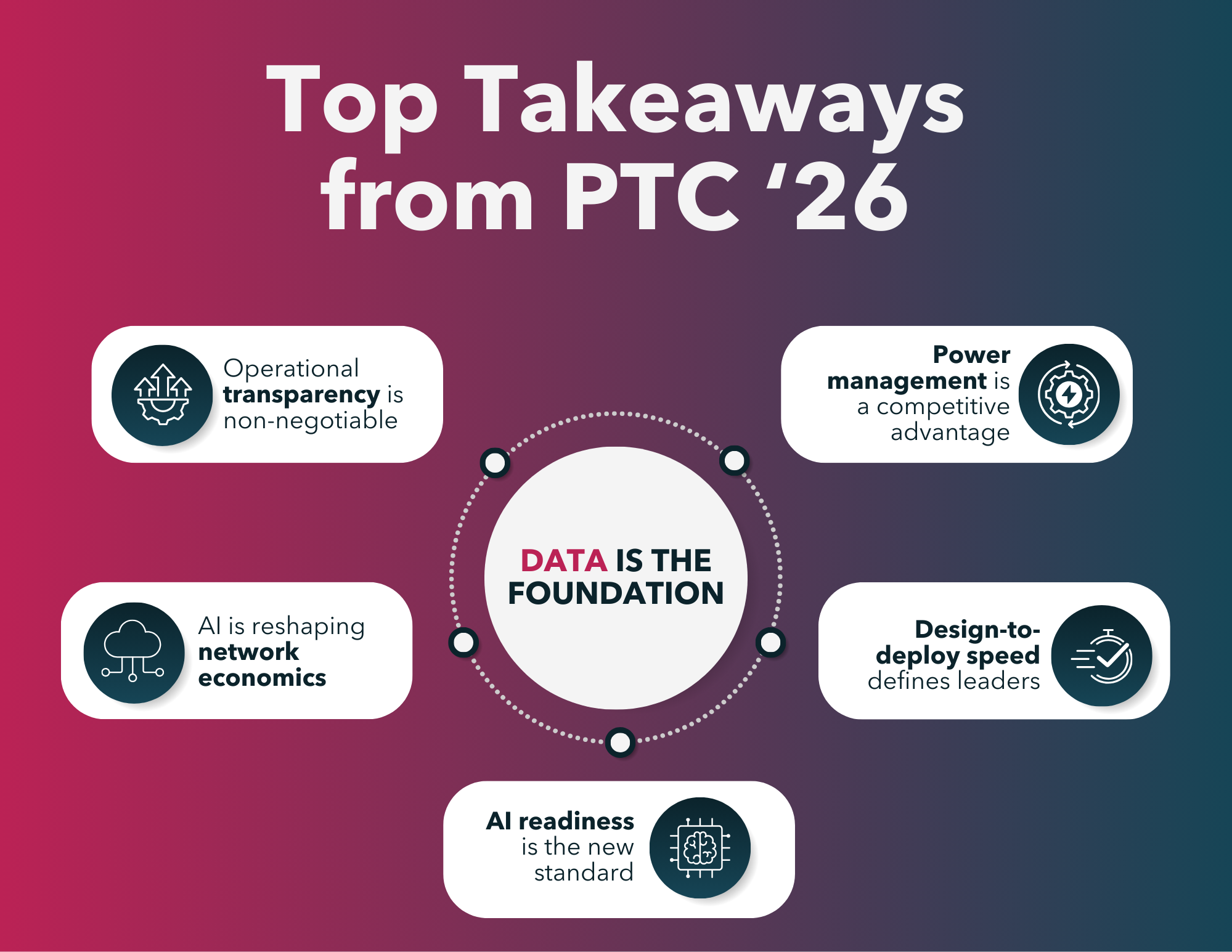
We walked away from this year’s event with six imperatives shaping the future of the industry:
Operational transparency is non-negotiable
AI will reshape network economics (speed is key)
Power management is a competitive advantage
Design-to-deployment speed defines leaders
AI readiness is the new standard
Trend 1: Operational transparency is non-negotiable
Fragmented data is a silent killer.
As automation and AI scale, operators need real-time visibility into every asset, watt, and workflow. That’s because unified operational intelligence isn’t a nice-to-have. Without a complete data source you can trust, you completely hinder your agility, compliance, and profitability.
Trend 2: AI is reshaping network economics and speed will decide the winners
AI workloads are exploding, and they’re re-writing the rules of network design. Traditional pricing models won’t survive in a world where low-latency and high-bandwidth connectivity are king.
Operators who can deliver scalable, predictable performance will capture demand. Those who can’t will be left behind.
Trend 3: Power management is shifting from a cost center to a competitive advantage
Energy costs and sustainability mandates are converting, and the stakes couldn’t be higher. Being able to track, bill, and optimize power consumption at granular levels will separate profitable operators from those drowning in rising costs.
Trend 4: Design-to-deployment speed defines market leaders
Capacity crises and supply chain delays have made it clear that speed is survival.
Operators who can model sites, integrate CAD drawings, and plan scenarios in real-time scale faster and smarter. The future will belong to those who turn complexity into velocity.
Trend 5: AI readiness is the new benchmark
AI is a litmus test for infrastructure. Predictable capacity, precision planning, and data integrity are the baseline for competitiveness in 2026.
Operators who deliver AI-ready environments through unified data and predictive analytics are poised to capture the next wave of growth.
Keeping Momentum in 2026
Walking out of PTC this year, one thing is clear to me: speed, data intelligence, and silo-busting is going to define the next generation of digital infrastructure.
Companies that are gearing up to embrace these imperatives are going to lead the transformation—and be better for it. And Carma is the catalyst that builds your data foundation. Ready to see how? Get in touch today.
Author Bio: Sydney Lauro
Sydney Lauro is Carma’s Director of Communications, leading strategic marketing and communication efforts. With a background in communications, demand generation, and GTM, Sydney brings a proven track record of shaping narratives that connect technology solutions to business outcomes for customers. Her experience in building thought leadership, market research for product development, and guiding strategic positioning helps Carma—and its partners—stay ahead in a rapidly evolving digital infrastructure landscape.