
Why You Can't Get a Clean View of Your Customer Accounts
By: Frank McDermott, CEO
Ask the Finance team at a data center or telco to pull recurring revenue by account, and you'll often get the same answer: "Give me a few days." Ask their Ops team what a customer's current service footprint looks like, and someone will start making calls.
The reason for this usually traces back to the same root cause: A disconnected customer data model.
What Your Customer Data Model Covers
Most people default to thinking about customer data as the CRM: accounts, contacts, contracts. But that's just one layer.
A complete customer data model covers everything connected to a customer relationship.
Who they are and what they've signed
What they're currently buying, down to the specific rack, circuit, and power draw delivering that service
What they're considering buying and what capacity exists to support it
What it costs to serve them, including vendor expenses tied to the assets in use
And what they're being billed, tied directly to the exact physical asset delivered
That last part matters more than most operators expect. When billing lives in the ERP, inventory lives in a separate system, and the contract lives in the CRM, there's no reliable way to confirm that what was sold, what got built, and what's on the invoice all match.
Someone has to reconcile that manually. And that's where revenue leaks.
The customer data model is the structure that connects all of it. When it's unified, every team works from the same account picture in real time.
Why Customer Account Data is so Scattered
Most CRMs on the market aren’t really built for our industry. They can’t track your customers, price book, and buying patterns accurately. And the customer journey spans multiple systems that don’t talk to each other, especially if opportunities, quotes, and sales orders are in separate systems.
Think about everything you need to track about your customer accounts.
The contract lives in the CRM
Power circuits and rack assignments live in inventory
Usage data sits in the BMS
Invoice history is in the ERP
None of those systems were designed to talk to each other, so the "customer record" is really a scavenger hunt across four or five platforms, some of which are updated manually.
Unifying account information into one data model is one thing that sets Carma apart. We correlate every element of a customer’s history down to everything they buy or considered buying, every asset consumed, and every billing item tied to those assets.
When that model exists and is accurate, your business operates differently.
What a Fragmented Account View Costs You
When you have these data gaps, you’ll feel the symptoms across your business.
Sales reps walk into renewals without a clear picture of the customer's service footprint. Operations provisions new services from email threads instead of system-generated tasks. Finance catches billing errors only when a customer calls to dispute (reduce) an invoice. Customers aren’t likely to remind you to initiate billing either.
All of those trace back to the same structural problem: customer data that was never connected in the first place. Research from Wipro found that 2–5% of all services delivered by the world's largest telecom providers go unbilled due to inefficient or misaligned processes, and order-to-cash cycle times commonly reach 75 or more business days.
For most operators, those aren't edge cases. They're the baseline.
Where It Gets Expensive: Customer Portals
One place I see fragmented customer data causing real problems is implementing a Customer Portal.
When you build a portal on top of disconnected systems, you inherit every gap as technical debt. A customer logs in and wants to see their current service footprint. Your portal has to pull from three systems to show it. Then they want to place an order. That request must be routed manually because the portal can't connect self-serve ordering to live inventory and pricing data. Every feature you want to add runs into the same wall. Multiple portals by product or region proliferate, frustrating customers further.
Operators who unify their customer data first, before building the portal, move faster and build more. They can add self-serve ordering, real-time capacity views, and automated provisioning because the foundation supports it. Operators who build portals on top of fragmented data end up maintaining a brittle experience that's expensive to improve.
AI Use Cases Depend on This Foundation Too
If your organization is exploring AI, that conversation should start with your customer data.
Predicting churn requires billing trends, utilization history, and support tickets in the same model
Detecting revenue leakage before an invoice run requires inventory tied to billing items in real time
Generating accurate quotes from live capacity requires your product catalog, inventory, and pricing to share a common structure
These use cases are achievable. But organizations that skip the data foundation end up with AI pilots that stall. Gartner predicts that through 2026, organizations will abandon 60% of AI projects unsupported by AI-ready data. Organizations that do succeed with AI invest up to four times more in foundational areas like data quality and governance than those that don't.
Unlocking the Advantage: Where to Start
Improving your data model has real tangible benefits that compound: Fast order-to-cash cycles happen because sales, operations, and billing are connected. Accurate invoicing happens because every billable asset is tied to a billing item automatically. Better renewals happen because reps have the full account picture before the conversation starts. Portals get built faster. AI use cases move from hype to achievable. Every team works from the same numbers.
Each outcome is meaningful on its own. Together, they describe an operator who moves faster, retains more, and builds more than competitors still working around the gaps.
The first step has to be taking an honest look at where your customer data actually lives and whether the teams who need it can access it in real-time.
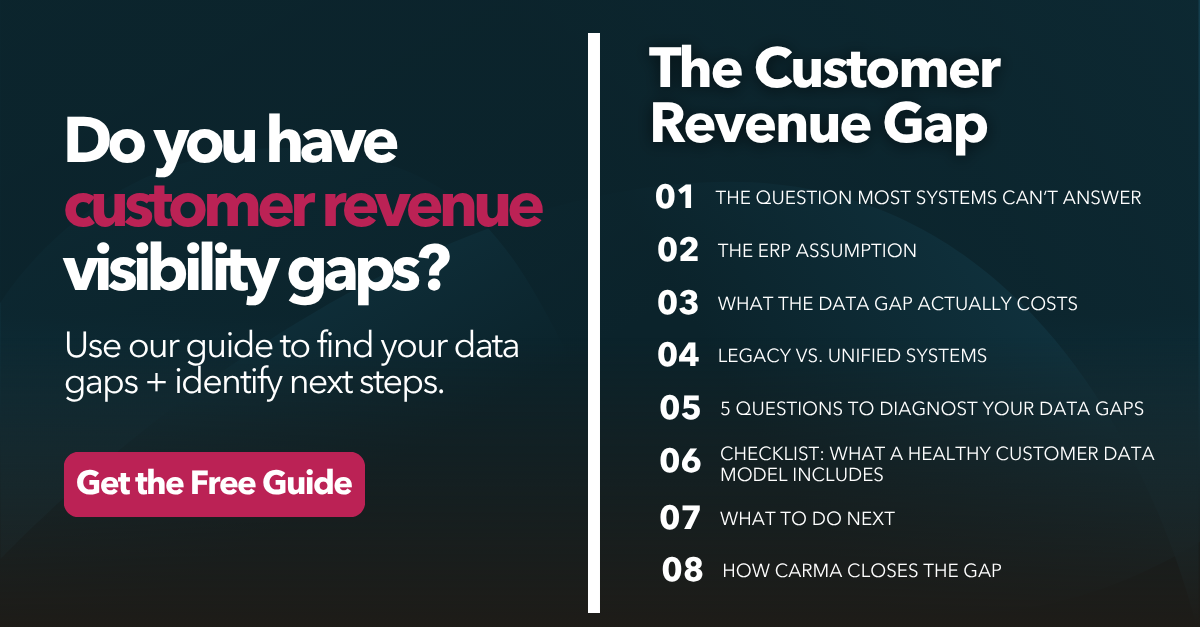
If you want a structured way to do that assessment, our guide walks through five diagnostic questions and a checklist for what a healthy customer data model looks like in practice.
Author Bio:
Frank McDermott is the CEO and co-founder of Carma. He created Carma based on his first-hand experience in the industry—from the construction, operation, and management of fiber networks, data centers, and microwave & cellular networks, as well as consulting across the industry prior to founding Carma. Frank holds a Bachelor's from Georgetown, a Masters in Project Management from George Washington, and a Lean Six Sigma Black Belt from Villanova. Prior to entering the telecommunications industry, Frank served a distinguished career in the United States Air Force.