
Why Digital Infrastructure Needs Purpose-Built CPQ
In most industries, a quote is a simple lookup. Pick the product, apply the price, send the document. In colocation and telecom, it’s not so simple. You have to figure out if there’s sufficient power where it needs to be or if there’s capacity on the route. And is this connectivity on-net, or does it ride a third-party circuit you pay for? Does the customer's site qualify for the product at all?
Get any of those wrong, and you’ve made a promise you can’t keep or closed a deal that loses money from day one. That’s the real CPQ problem in digital infrastructure, and it is why quoting here is harder than almost anywhere else.
Quoting Infrastructure Is a Different Kind of Problem
A data center or carrier quote depends on facts that typically live outside the sales system. What makes this so challenging is the constant change in your sites.
Capacity is changing rapidly as installs and disconnects occur, made more complicated when you want to track reservations and ROFO deals in pipeline.
The same bandwidth costs one thing on-net and another off-net, because off-net means a vendor circuit with its own recurring cost attached.
Products are site-specific, so what a customer can buy depends on where they are connecting.
Deals routinely span multiple sites and multiple service agreements at once. And the work does not stop at the first sale.
Renewals, disconnects, and change orders each require knowing exactly what is in service today before you can quote.
Increasing demand is making all of this heavier. Global data center capacity is expected to double in the next five years, and interconnection density is climbing across every major hub.
More capacity, more sites, and more interconnections mean more quotes, each one resting on physical facts that are constantly changing underneath the sales team.
Why Generic Quoting Tools Struggle in Telecom
Most quoting software was built for simpler industries: catalogs of products with fixed prices, sold the same way everywhere. That model works for seats, licenses, and boxes. But most have no clue what a cross connect is, how power billing works, or that a route has capacity that can run out.
So, operators are left with two options, and both have costs.
The first is to bend a generic tool into shape. That means months of custom development to teach the system about power agreements, capacity, site-specific catalogs, and the pricing logic that governs them, followed by ongoing maintenance every time the business changes. The customization becomes its own liability: brittle, expensive, and dependent on whoever built it. Not to mention, if the CPQ tool doesn’t connect to live, reliable data, you’re still quoting on stale, inaccurate inventory.
The second option is worse: manual reconciliation. Teams quote the hard parts in spreadsheets on the side, outside any system of record, where pricing goes stale and every quote is only as accurate as the last person to touch the file.
Either way, the quote is disconnected from the network or site it describes. And a disconnected quote is where revenue leaks.
The industry has recognized this alignment problem for years. But solving this challenge with most of the available systems has been an uphill battle. That’s one thing Carma has been passionate about addressing.
The Carma Advantage: A Connected Data Model Built Specifically for Telecom
Carma's approach is different at the foundation. Our CPQ is built natively on the same unified data model that holds your inventory, CRM, and invoices, so quotes are generated from the actual state of the network rather than a separate catalog that has to be kept in sync with it.
That means constantly knowing what power is available across your sites. And when you quote connectivity, Carma knows whether the route has capacity and if it rides your infrastructure or a vendor’s.
Because the quote, the order, the provisioning workflow, and the invoice all draw on one model, a service moves from sold to billed without losing fidelity along the way. We’ve found this is something a general-purpose tool simply can’t replicate, because the advantage lives in having an accurate data foundation.
Optimize Sales with Guided Product Selection
In an environment where products are site-specific and pricing depends on where and how a customer connects, a seller working from memory or a generic catalog will eventually put the wrong product, the wrong bundle, or the wrong price in front of a customer.
Carma's guided product selection tool closes that gap by making your own catalog do the work.
You’ve done the foundational work building price lists, catalog, and bundles once, with the rules of your business baked in. That lets Carma automatically surface the right products for each quote instead of Sales having to hunt through a master list and hoping the price is current.
New and Noteworthy: Faster Renewals and Disconnects
We're constantly evolving Carma based on feedback from our customers, and one gap kept coming up: renewals, disconnects, and change orders were slower than they should be. Because so much of an operator's revenue comes from already-installed services, the work of extending, changing, or ending them shouldn't mean rebuilding an order from scratch.
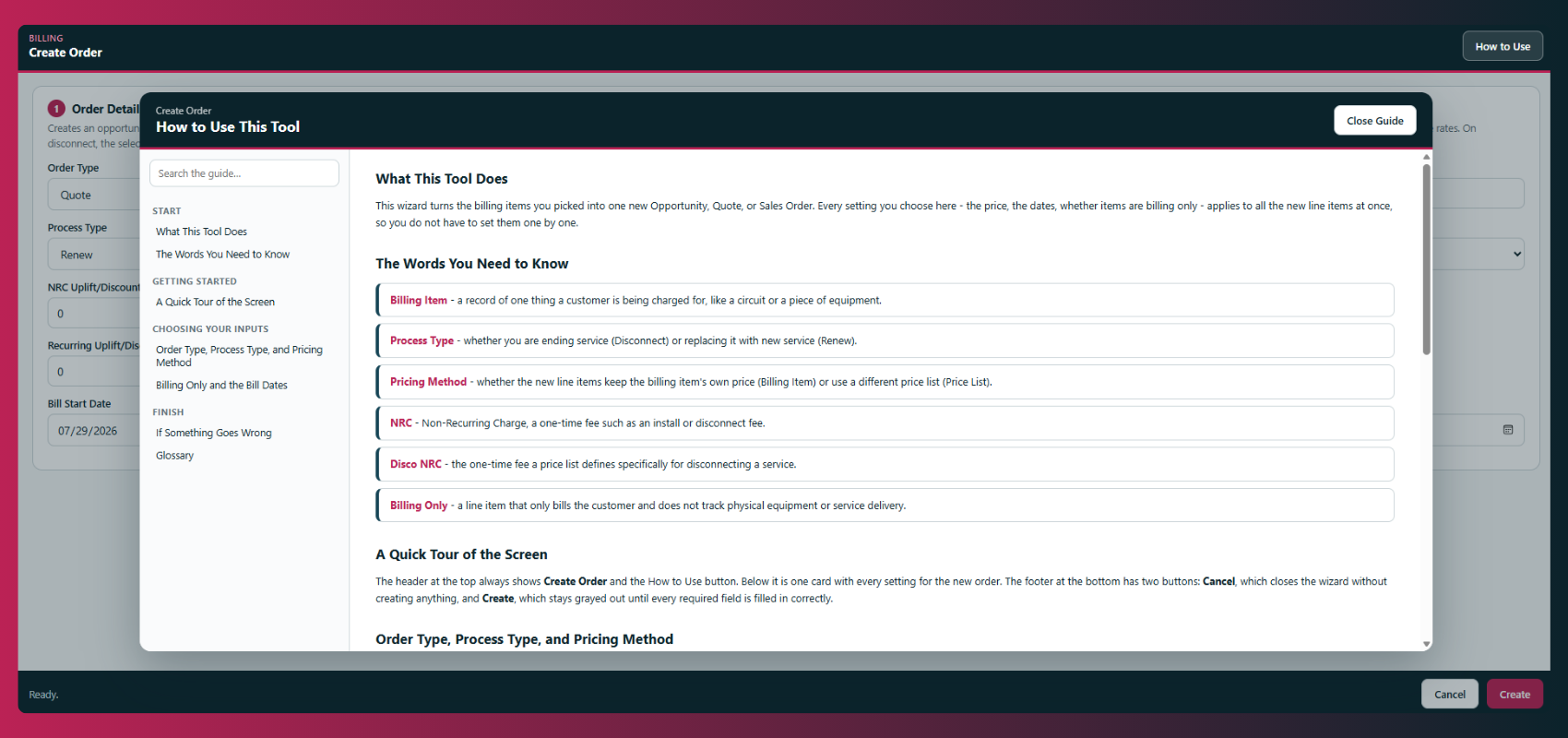
Our new Billing Item Order Wizard starts from what a customer already has in service. A simple workflow takes you straight into a renewal, disconnect, or change order, with pricing and terms applied consistently across the whole selection.
Why it matters: This removes any manual rebuilds that made these everyday orders slow and error-prone and kept them anchored to live billing data.
The result: The revenue you already have becomes easier to protect, and the revenue you're adding starts from an accurate picture of what's there.
Custom Tools for a Complex Industry
Quoting in digital infrastructure is hard because it's really a question about power, space, capacity, and cost, decided against a network that keeps changing.
Generic tools answer the easy version of that question and leave operators to bridge the gap with customization or manual reconciliation. Carma bridges the gaps with a tool designed for the complexity and requirements of our industry and is a holistic solution, with one connected data model.
See how CPQ works when it’s connected with our data mode. Get in touch.