
From Hype to High Performance: Why Context is Critical to Unlocking AI
By Frank McDermott, CEO
I recently listened to a podcast, Telco has a context problem, that talked about a key issue preventing AI use cases from taking off that wasn’t just data integrity issues (which, of course, is still a massive problem). That less-known challenge: context.
At Carma, this is something we think about all the time. So, hearing it articulated so clearly in a broader industry conversation tells me the market is finally catching up to a problem we’ve been solving for years.
What is the Context Problem?
While everyone is pretty familiar with AI’s data dilemma (garbage in, garbage out), few people have been talking about the importance of training AI agents on context.
And by context, we mean all the logic, business processes, and rules that define how you actually operate. Basically, what should your AI agents actually do with all that data.
So, why’s that a problem? For most organizations, those processes live in peoples’ heads, buried in legacy systems, or were never formally defined at all.
The podcast absolutely nails the challenge here: without context, you can’t really unlock your AI use cases. But I think there’s more to unpack about what context is really required and why most organizations aren’t as ready for it as they think.
Everyone is Chasing AI Hype
Every telco and data center exec I speak with is thinking about AI. The pressure and potential are very real. A lot of the time, they’re focused on the outcomes of what AI will be able to do for their business. But there’s a lot that needs to be done before they can get there.
AI at scale is all about doing more:
More designs completed (and faster)
Fewer billing disputes and revenue gaps
Faster provisioning and service delivery
Better outcomes for customers
But the magic behind getting AI to do any of that for you: is telling your agents what your business processes actually are. How do they make sense of your data? Make decisions about where you can sell, what your oversubscription tolerance is, and so on.
The Problem: AI Requires a Foundation that Most Companies Don’t Have Yet
If the knowledge AI agents need lives in peoples’ heads, is buried in legacy systems, or isn’t formalized at all, then you have a massive barrier to unlocking any AI productivity.
This is something we regularly see when working with our customers. Often, the processes we need to extract are inconsistent across teams, regions, business units, or legacy systems, or they evolved informally over time without anyone properly defining them.
Before you can give AI the context it needs, you have to do that work.
Add fragmented data to that, and the challenges compound.
In most digital infrastructure businesses, operational data is spread across disconnected systems: inventory in one place, billing in another, network design in a spreadsheet, customer history somewhere else.
When data is siloed like that, you can’t codify business logic in any meaningful way because the data those rules depend on isn’t connected or trustworthy. Swivel chair operations blind systems to process.
So, the challenge cuts both ways.
Great data + no context = AI can't make decisions
Bad data + clear context = Inaccurate AI outputs
You really need both. You can’t give an AI agent context for a process it can’t see end-to-end.
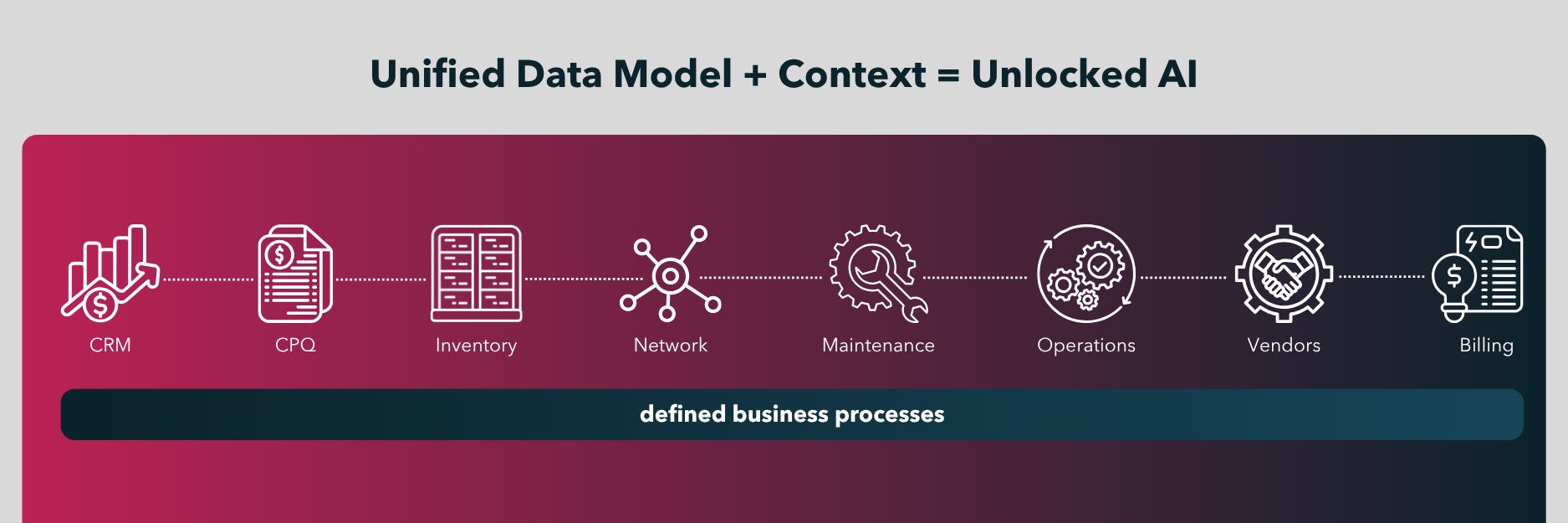
Business Processes Are the Bridge Between Data and AI
When we work with customers, we look at their data with all this context in mind. That’s why we don’t just work on normalizing data. We help them develop their Business Process Flows.
These flows let you map your exact workflows into Carma, so employees can move through pre-defined stages, ensuring required information is collected and work advances from one team to another seamlessly. The same steps, in the same order, give you the defined business outcome you desire every time.
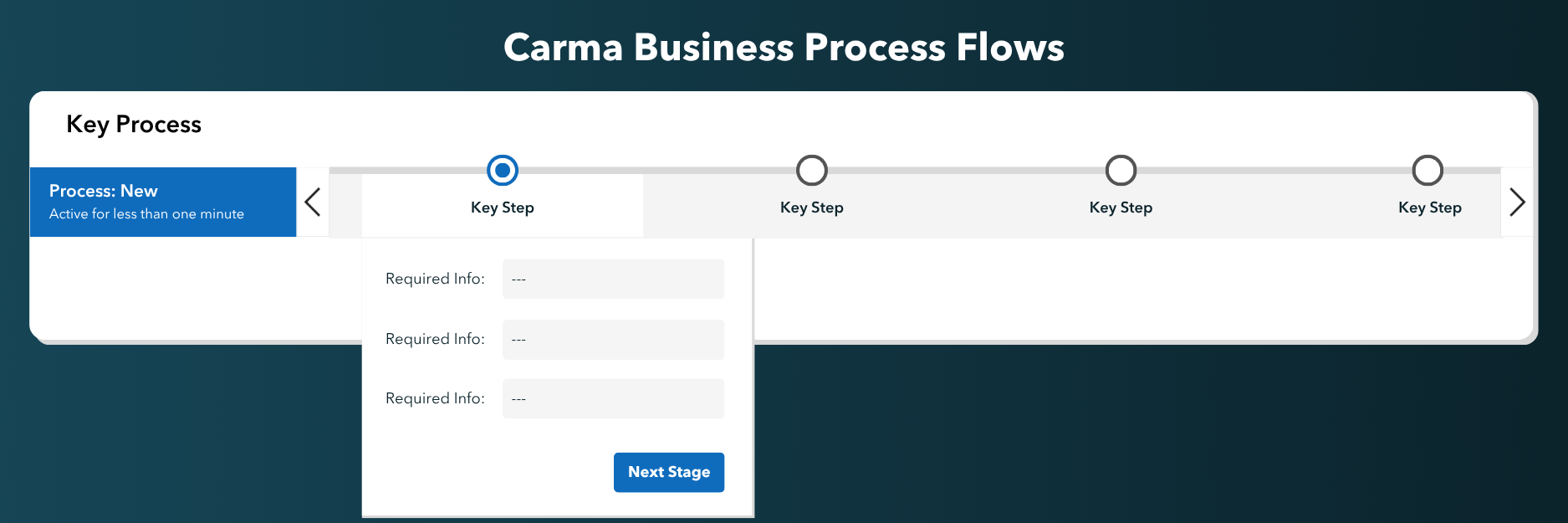
Consider a quote approval workflow or the exact sequence to provision a power agreement when installing power. These processes have specific steps, rules, team handoffs, and decision points. Carma lets you document them so there’s no manual handoffs or dropped steps.
For instance, a remote hands ticket submitted through a customer portal should automatically create a service order, kick off a work order, and trigger billing when the work closes.
For most firms, the knowledge of the steps and requirements exists as institutional memory. That knowledge isn’t written down in a way any system can act on. Which means your AI agent, no matter how capable, is working without the context it needs.
When you take the rules out of people’s heads and build them into your operating model, two things happen:
Your teams become more efficient right away
And you create the context that agentic AI can actually use
What This Looks Like in Practice
At Carma, we built Business Process Flows into the platform because we kept seeing these context gaps.
The result: A 10x increase in solution designs produced and zero SLA breaches for customer incident notifications.
How? By capturing the account, contact, service, design, and provisioning data in one system, and making it available for impact analysis during an incident. That means you have the data ready in the next inevitable emergency.
And that’s before you even add AI agents. That’s just the outcome of getting your operational processes codified and having good data. The AI opportunity builds from there.
The Foundation Determines the Ceiling
The podcast makes a point I keep coming back to: a small, well-scoped AI use case can unlock compounding value over time, but only if the foundation is solid.
Each process you codify becomes a building block. Each data source you normalize and connect extends the range of decisions AI can make reliably. The organizations that invest in this infrastructure now will be able to move faster than competitors who ignore these challenges.
The hype will settle. It always does. What will remain is a clear divide between the companies that built the operating model first and the ones that didn’t.
Want to see how Carma’s Business Process Flows help digital infrastructure companies operationalize their workflows and build AI-ready data? Request a demo.
Author Bio:
Frank McDermott is the CEO and co-founder of Carma. He created Carma based on his first-hand experience in the industry—from the construction, operation, and management of fiber networks, data centers, and microwave & cellular networks, as well as consulting across the industry prior to founding Carma. Frank holds a Bachelor's from Georgetown, a Masters in Project Management from George Washington, and a Lean Six Sigma Black Belt from Villanova. Prior to entering the telecommunications industry, Frank served a distinguished career in the United States Air Force.